
14 February 2026 update

The rain dance

1 February. There had been a water deficit the day before—nearly six days in a row without a drop of water. In these latitudes, the stressful situation seemed almost unbelievable. At Camp 1, extreme steps were implemented to address the situation: reserves were rigorously handled, constant vigilance was maintained, and porters were organized to trek to Galuwé to secure supplies. Then everything changed, as is common in these climates. The rain came again in buckets while the crisis management strategy was being put into action.

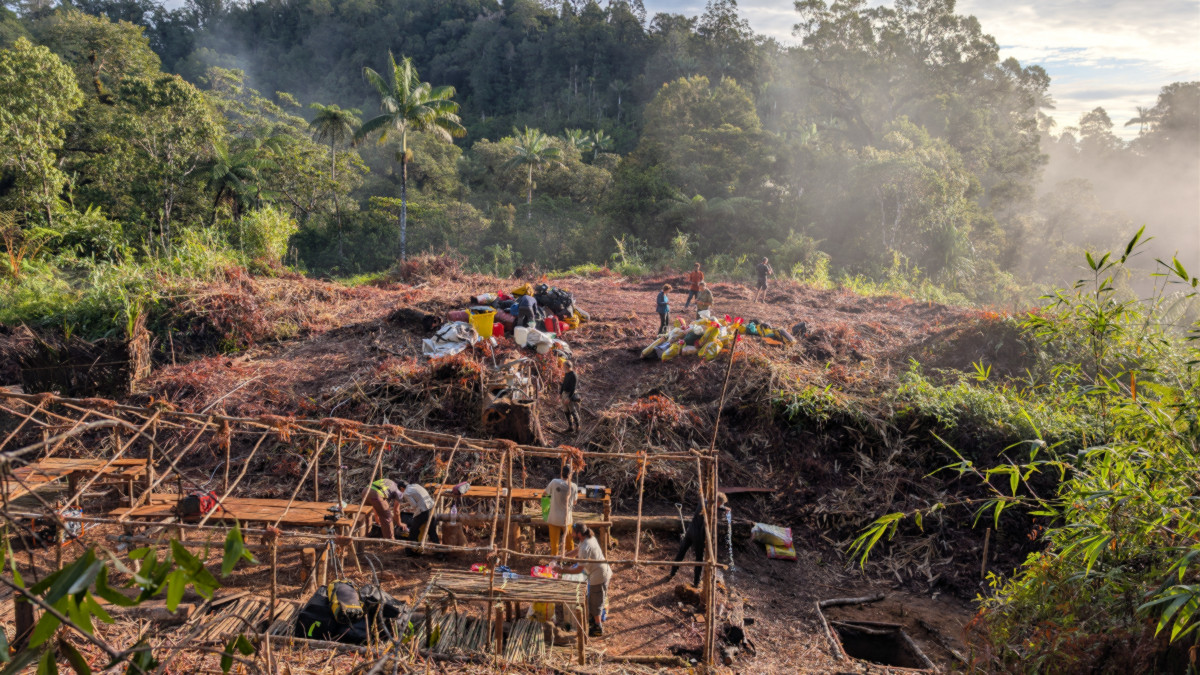
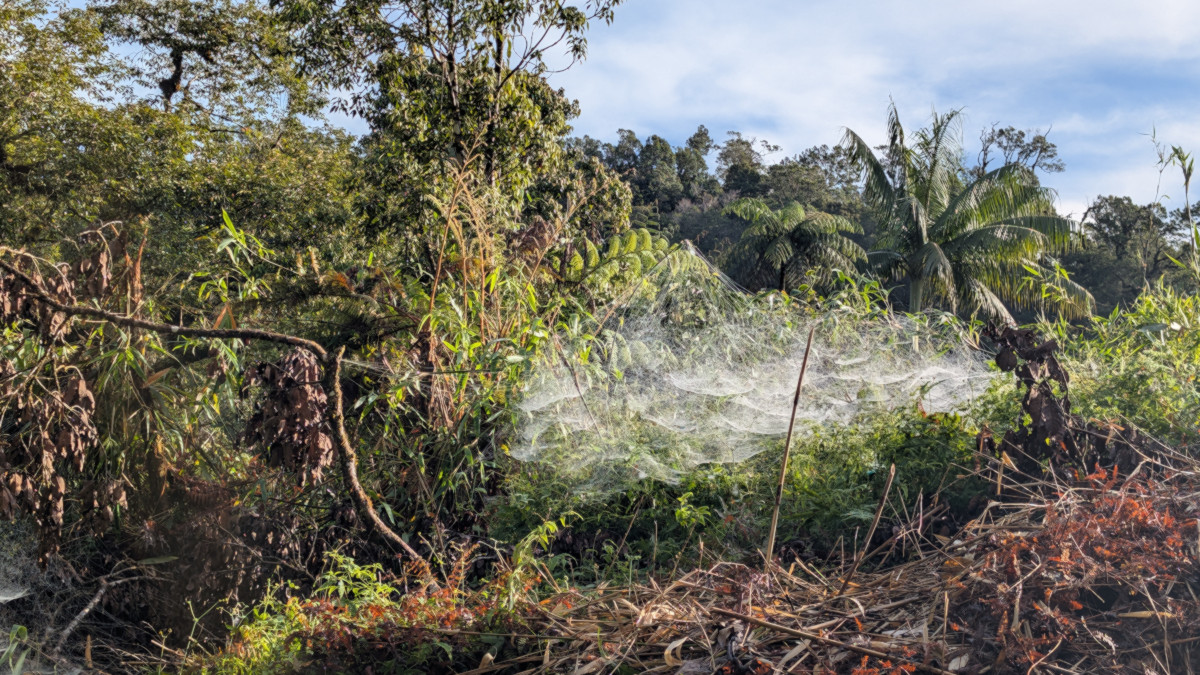
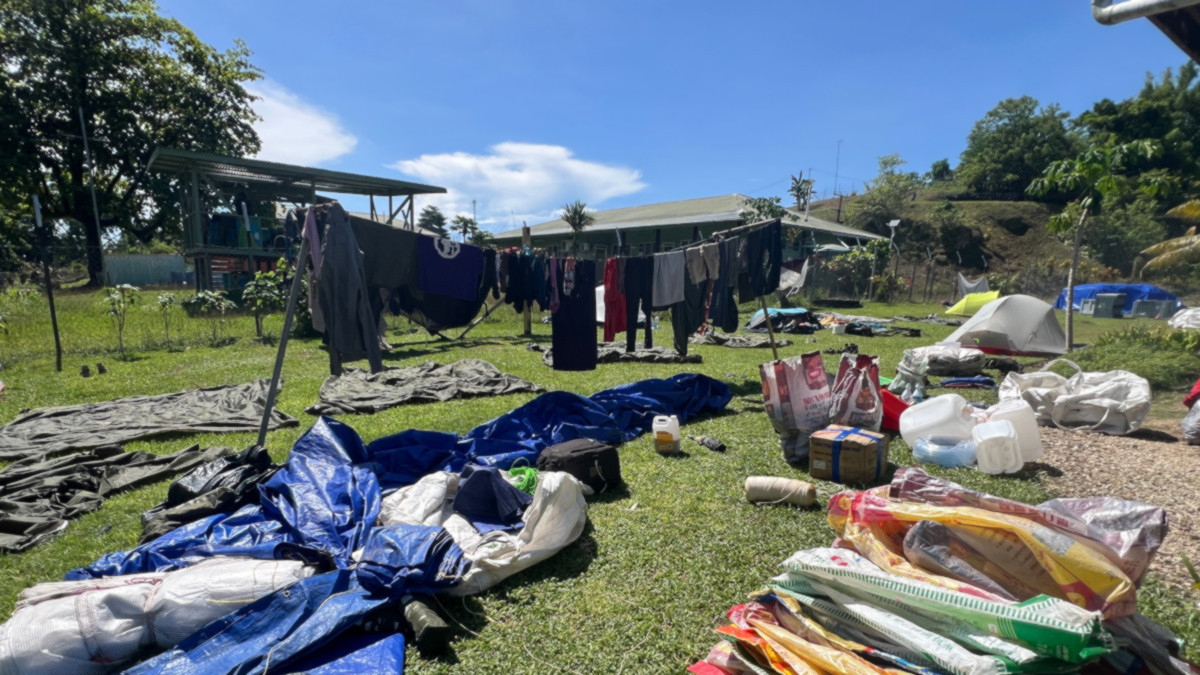
There is no hesitation, and everyone gets to work. The drains from the tarps and tarpaulins are repositioned to catch every drop of water, and basins are lowered beneath makeshift gutters. Water is constantly being stored, purified, and ready for use later. In each camp, two stores of more than 200 liters are rapidly built.

Once bitten, twice shy: here, we won't be caught off guard again.

Water storage system for dry days

In search of sumps

Between 1 and 7 February, the teams at Camp 1 are organising themselves to explore the two canyons that run alongside the camp: Galuwé to the north and Poy to the south.

On 1 February, a new surface route was opened on the ridge, heading upstream from the two canyons towards the west. The aim is to reach a small col separating the Galuwé from the Poy, about 1.5 kilometres from the camp, and then attempt a descent into one or the other.

Towards the Poy

A first team — Luc-Henri, Christophe, Carlos and Didier — makes its way through dense bamboo forests. At the end of the day, they finally spot the riverbed, encased in a chaos of boulders and pebbles. But time is running out: they estimate it will take them an hour and a half to reach the bottom. They turn back.

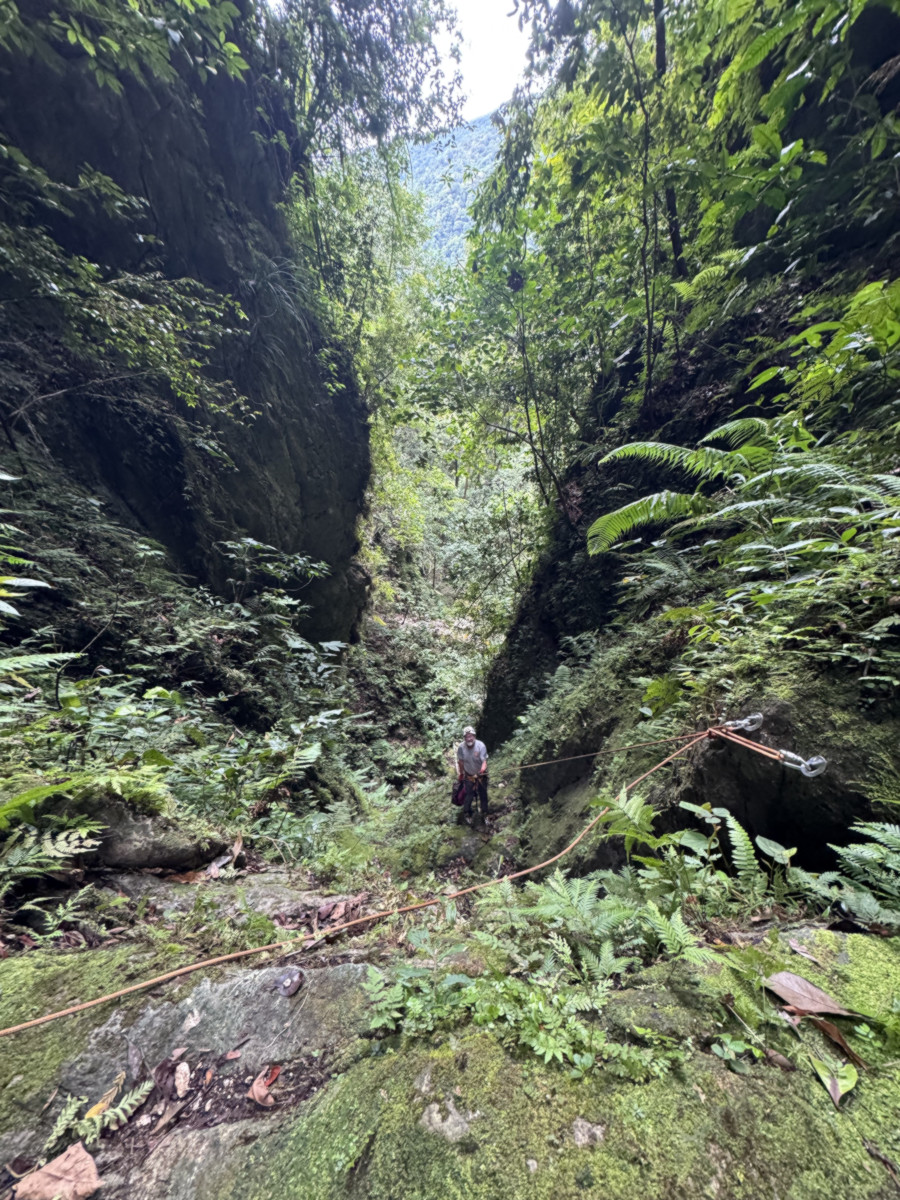
Michel and Bernard did not arrive at the base of the dry canyon until 3 February, aided by two ropes that were about 10 and 15 meters long, secured to a tree fern. After walking a few hundred meters downstream, they encountered a narrowing identified by a rise, which was succeeded by two large potholes filled with trapped tree trunks. The canyon became increasingly confined and twisted. Lacking adequate equipment, they could not navigate past the barriers.

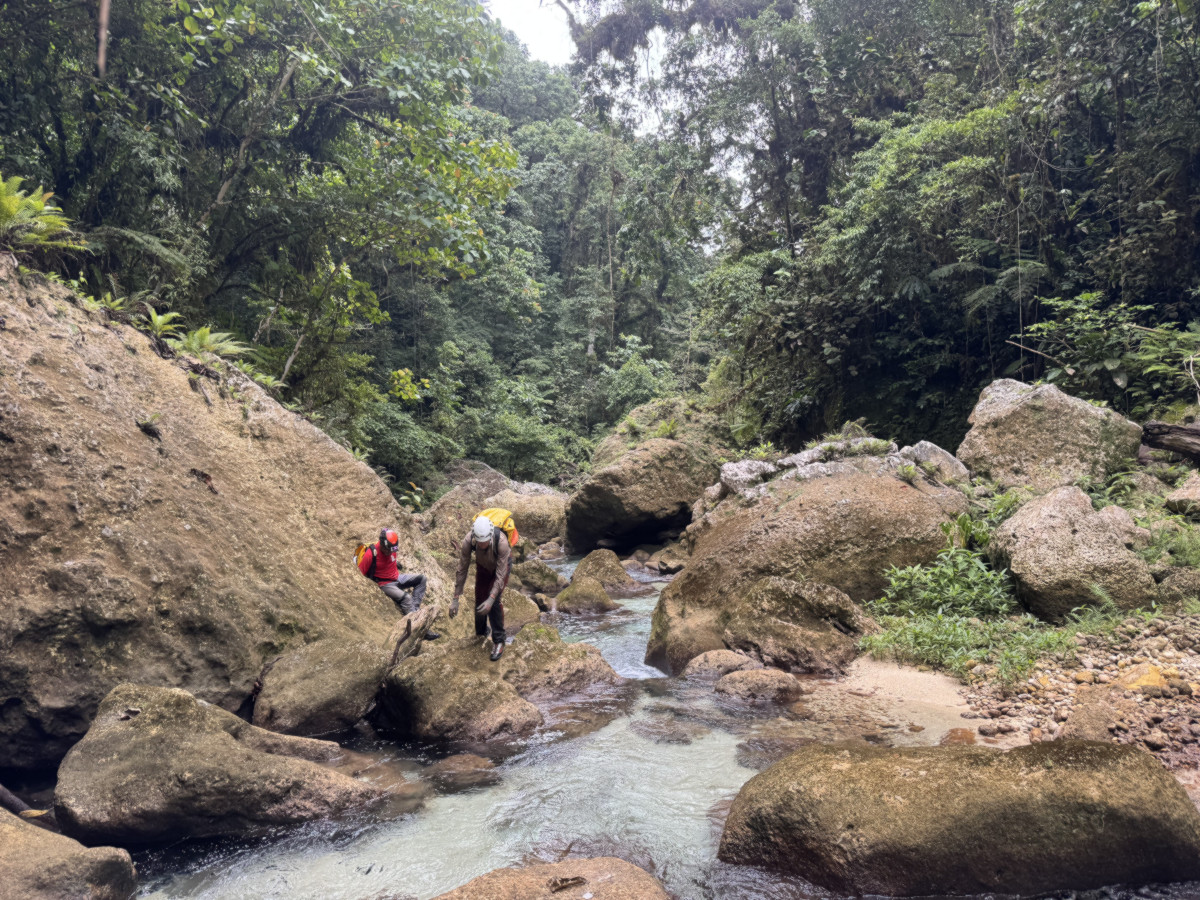
Before returning, they also investigate upstream. In that area, the riverbed expands and is filled with a significant landslide from the left bank. Entangled tree trunks and remnants of past floods are visible. However, the fine sediments and plant life suggest that floods occur rarely. There are no indications of any sumps, and time is limited. They need to ascend.

The bed of the Poy upstream from the access point

Camp 2 — first jackpot

At Camp 2, on the other hand, the excitement is evident. Reaching the enormous cave entrance seen on satellite photos by Benjamin Lans, the cartographer who stayed in France, and then verified during the initial helicopter flyover is the shared objective. This would be a major sump located on top of the plateau overlooking the camp.

With machetes in hand for the two Papuans, Jack and Nerville, the team—which included Lionel, Sylvain, Laurent, Julien, Katia, Nicolas, and Denis—came to their Holy Grail, a viewpoint known as "Le Belvédère," after an hour and a half of hiking and a 350-meter elevation. Jean-Marc used his GPS to guide them. Yes, the sump is present. a minimum of 150 meters of emptiness to drop to the bottom. The squad could just watch it without ropes. It was a great delight. The frustration was the same.

In the days that followed, multiple attempts to access the Galuwé were unsuccessful due to cliffs. The river was still unreachable without our supply of ropes.

Descent to the Eye of Mayang, end of rope, we won't go any further.

Camp 1 — The inconveniences

Bernard, Natalia, Joash, Franck, and Michel try to descend from the col on the north side in the direction of Galuwé. Bernard, Natalia, Joash, Franck, and Michel try to descend from the col on the north side in the direction of Galuwé. They have to retreat roughly 200 meters from a likely sump that was seen on satellite, because time is running out.

A fresh group comprising Joash, Franck, and Natalia visits the location the following day and resumes the descent. They arrive at the top of a cliff where it takes almost five seconds for a stone thrown into the emptiness to reach the bottom. Joash exclaims, "A cave!" from atop a tree. Access is still blocked, but a sinkhole appears to be plainly visible below.

Moving through this forest, our green hell, is a complex task due to the lack of visibility.

On 5 February, Michel, Natalia and Franck made another attempt. They wanted to bypass the steep, vertical section that had blocked their path two days earlier and reach the Galuwé trail, clearly visible on satellite photos, further upstream. The access was steep. They crossed a first perpendicular gully, then a second, cut by a recent landslide. The path is very exposed, and they must be careful not to slip. Beyond a third gully, an 8-metre drop stops them in their tracks. Using a rope from their bag, Natalia and Franck manage to cross, but unfortunately they have to stop there: the bed of the Galuwé, visible about 40 metres below, remains inaccessible. On 7 February, Carlos, Christophe and Franck, this time equipped with ropes and climbing gear, finally set foot in the dry bed of the Galuwé. Their last piece of rope just allows them to descend an 8-10 m drop downstream. Beyond that, the canyon, which receives water from small impenetrable resurgences, continues its course, and more ropes will be needed. Upstream, progress is easier, but it is already time to turn back as the afternoon is well underway. Here, it gets dark around 6.30 p.m. Moving through this forest, our green hell, is a complex task due to the lack of visibility.

Christophe and Franck rig a few ledges in the Galuwe

During these first days of February, the team of scientists, Romain from the National Museum of Natural History in Paris, Pita and Jerrica from the Binatang Research Institute, set up an advance camp on the edge of the Mayang resurgence, where the proximity of water attracts a richer fauna than on the ridge. The film crew, consisting of Yann and Patrick, followed closely behind. For three days, assisted by Brendan, one of the Papuans from Galuwé present at Camp 1, they collected numerous samples of both aquatic and terrestrial fauna.

The results are in: Jerrica, an aquatic fauna specialist, believes she has discovered two new species of fish. These discoveries, combined with the enjoyment of camping in the forest, put smiles on their faces and almost make them forget the long, steep walk back!

Franck, Natalia, and Didier, who went to help them carry the equipment, take the opportunity to try to access a resurgence downstream from Mayang that they spotted earlier. Their attempts on land fail, and the only way to access it is by crossing the Galuwé riverbed, which reaches more than fifteen cubic metres per second here, so a rope will be needed to ensure their return.

Franck franchit le tronçon de falaise en aval pour accéder à la résurgence.

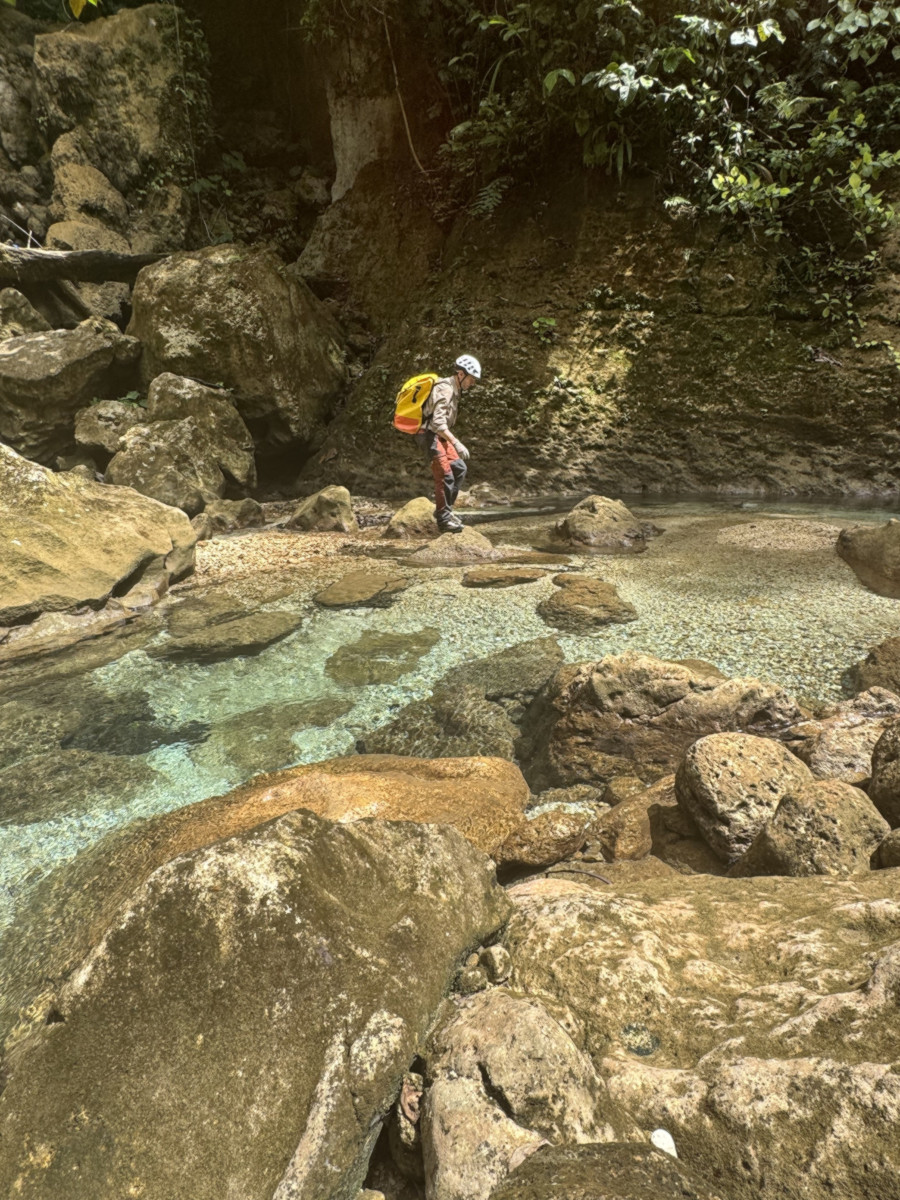
This will be done on 9 February by Natalia and Franck, but the resurgence, which flows at 300 litres per second, emerges from the first few metres of an impenetrable siphon. Without giving up, they cut towards the Poy riverbed, some 300 metres downstream, and reach the resurgence that feeds its final course. The water emerges from an impenetrable conduit in the middle of a 20-metre-high wall. Their disappointment is mitigated by the beauty of the surroundings.

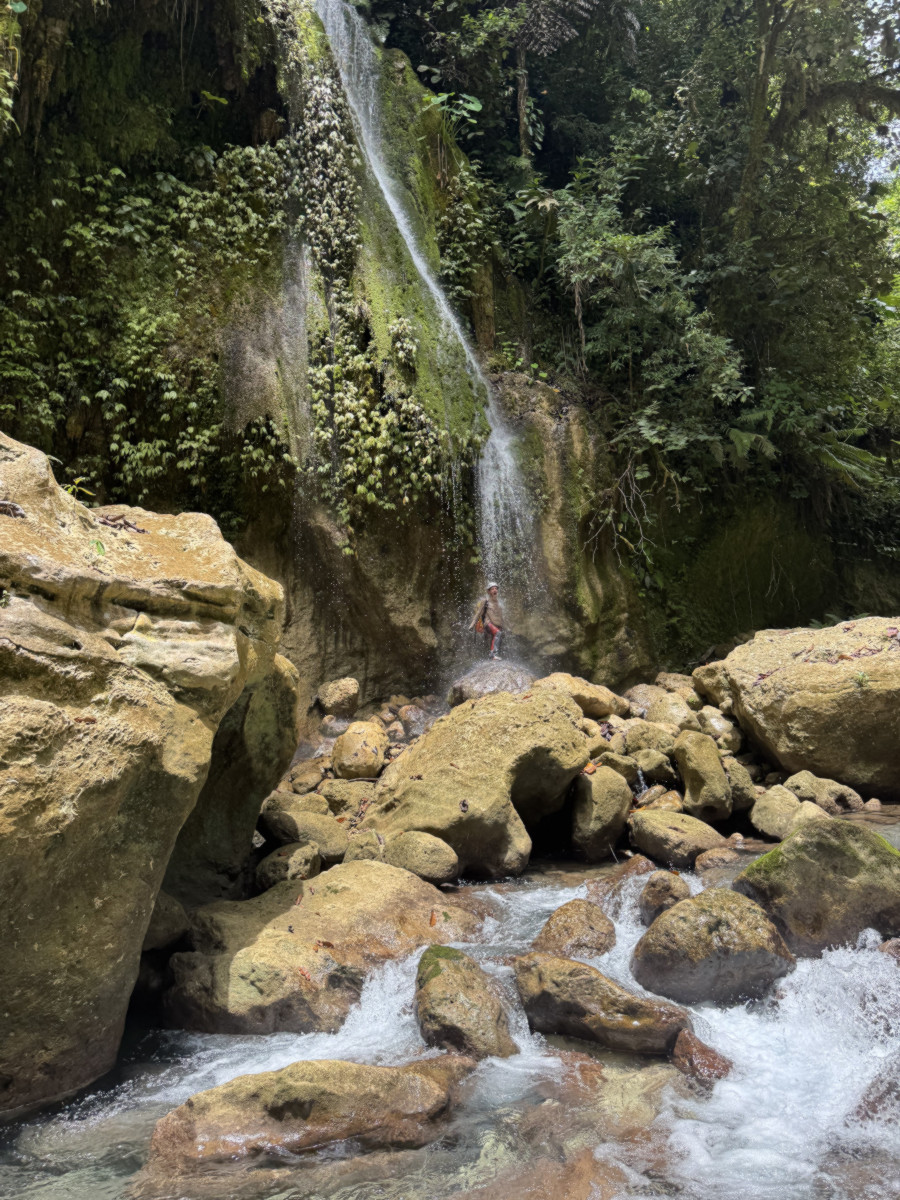
The charming resurgence of La Poy

These two resurgences were among the last hopes for major speleological objectives around Camp 1. It is becoming increasingly clear that moving the camp to more favourable areas is necessary.

Camp 2 — Mayang's eye

On 6 February, Sylvain, Lionel and Elven attempted an incursion into the ‘Eye of Mayang'. It is perhaps a big sump... or simply a gigantic giant's pothole more than 20 metres in diameter, visible on Google Earth. After descending about fifteen metres, they emerge at the edge of a 50-metre precipice overlooking the bed of the Galuwé River more than 350 metres below.

Rigging and unrigging progression ropes towards the Eye of Mayang

On 9 February, a final attempt added 150 metres of descent. However, analysis of drone images revealed pools completely filled with water and more than 200 metres of elevation remaining to be rigged in order to reach the bottom of the Galuwé. The decision was made to abandon the objective.

This is a big disappointment, because the goal seemed very promising.
The impressive eye of Mayang

8 février — Finally the sea freight

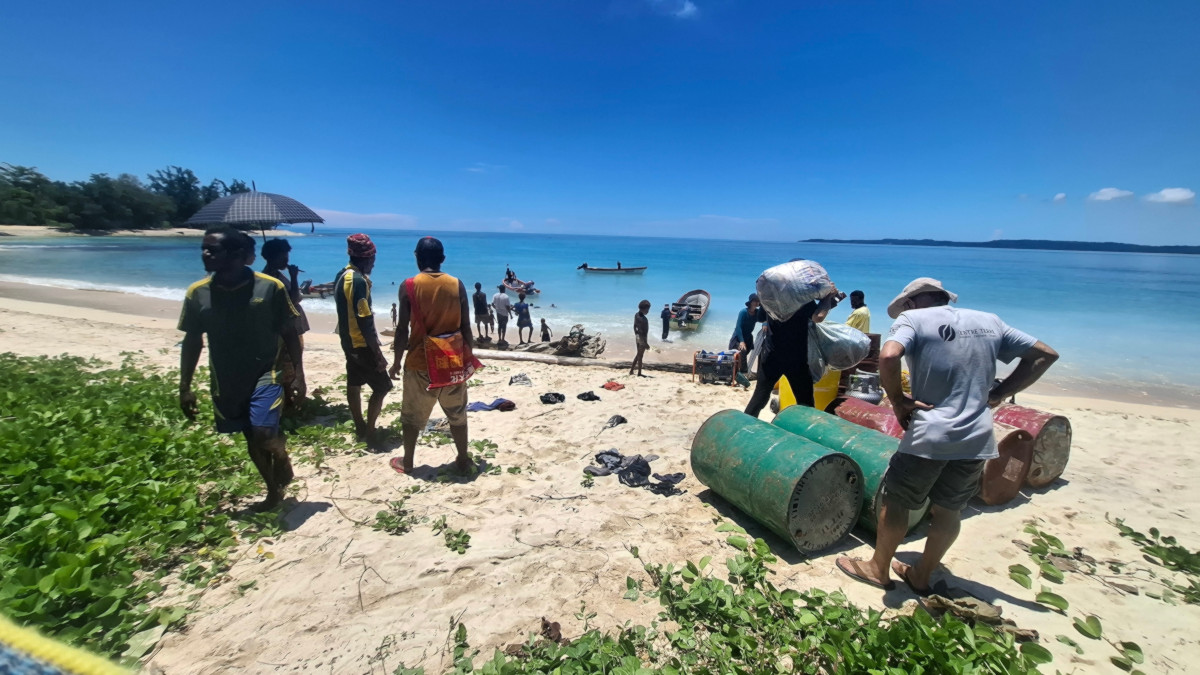
Since 1 October, three palletised crates have left France. Inside: everything needed to make the expedition possible. Ropes, equipment, technical gear — the very backbone of the expedition. But their journey has turned into a logistical saga.

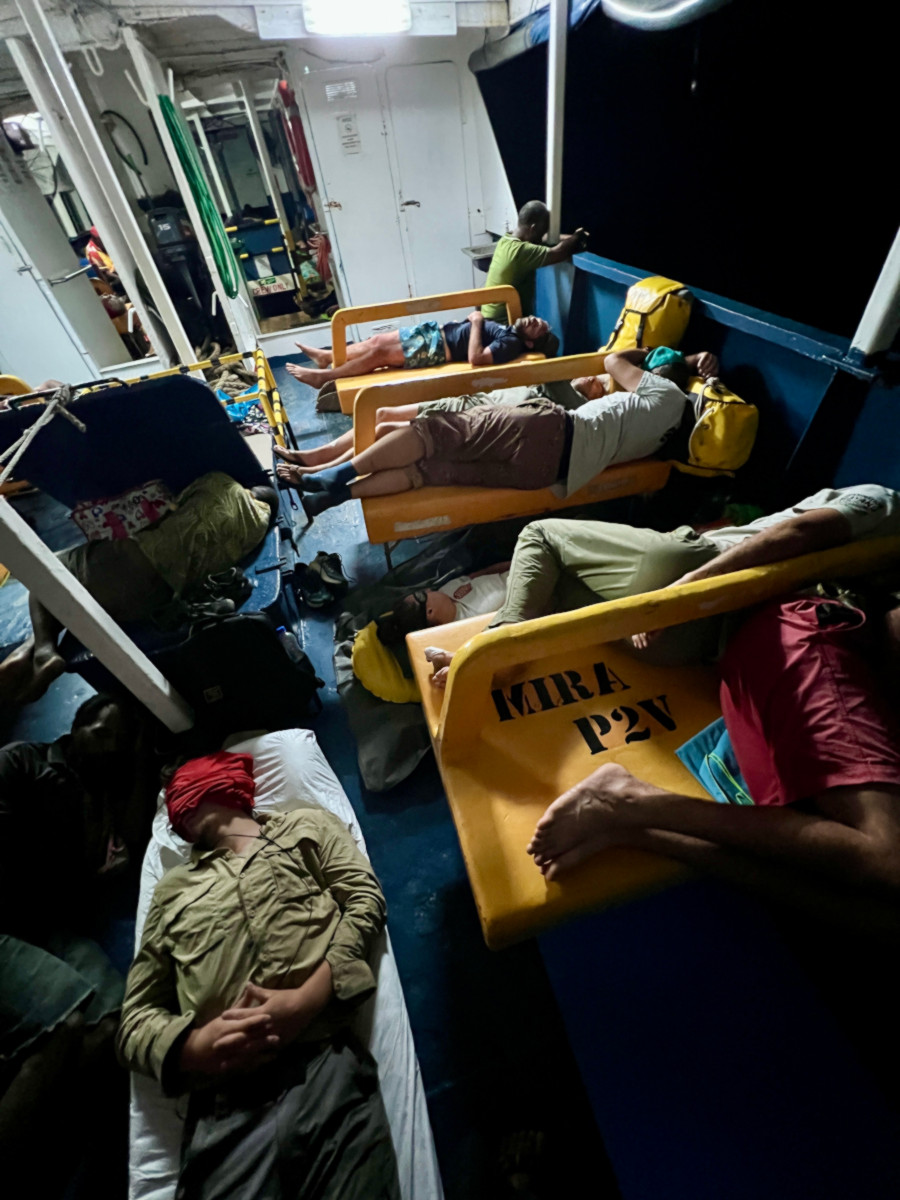
Bernard has been following every step, almost hour by hour. The first container ship is delayed by a fortnight. Its transhipment is slow, delaying its arrival in Singapore. In Lae, there was an eight-day wait between customs clearance and transfer to Rabaul on the Consort, the only ship providing a connection to this destination. Finally, there was the last leg: the ferry to Palmalmal. This series of setbacks spread over more than 20,000 kilometres weighed heavily on morale and organisation.

The long-awaited sea freight

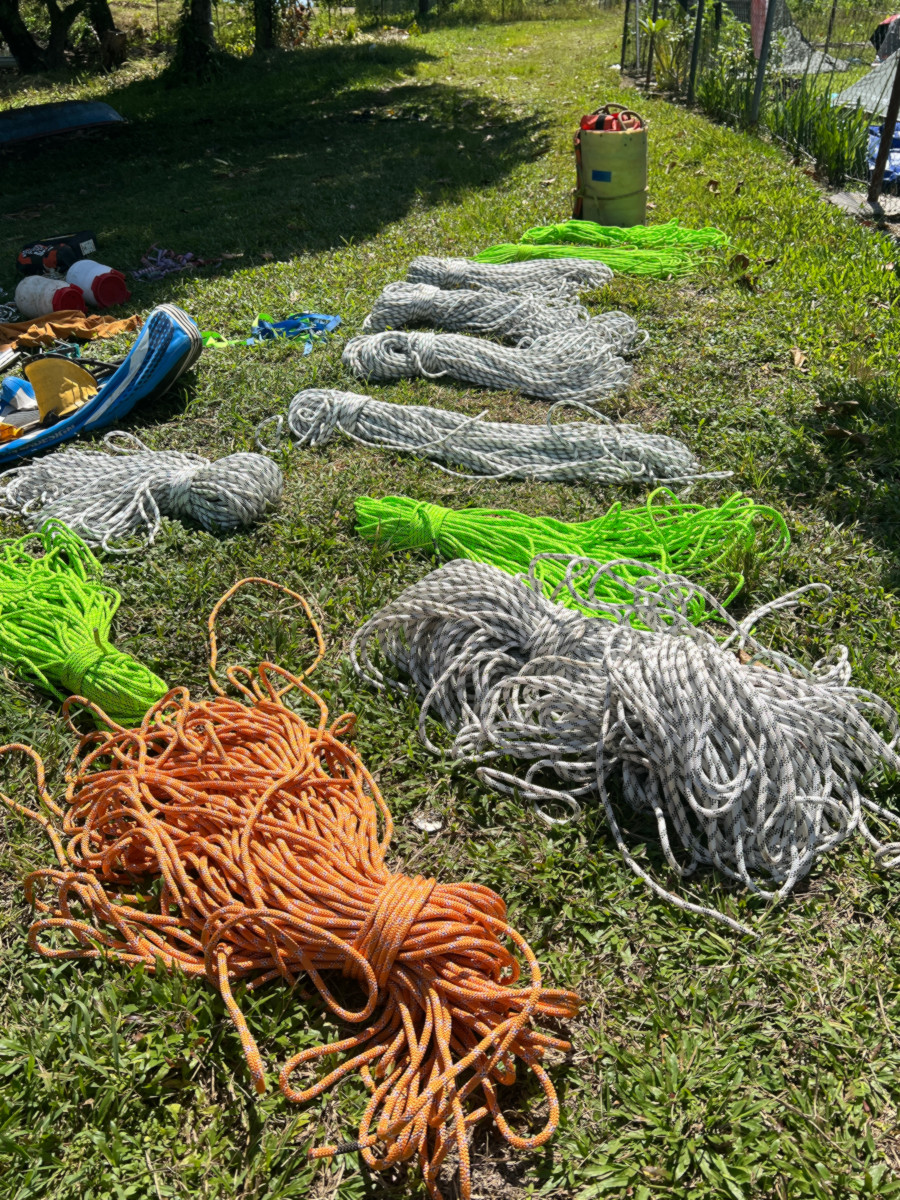
Meanwhile, on the ground, teams from camps 1 and 2 are adapting. They are exploring with the resources at hand, 200 metres of rope hastily packed before departure. They are exploring, but only half-heartedly. They are approaching their objectives without really being able to go all in. For days, everyone has been waiting for these crates as if waiting for salvation.

At last, the ropes, a contribution from Courant!

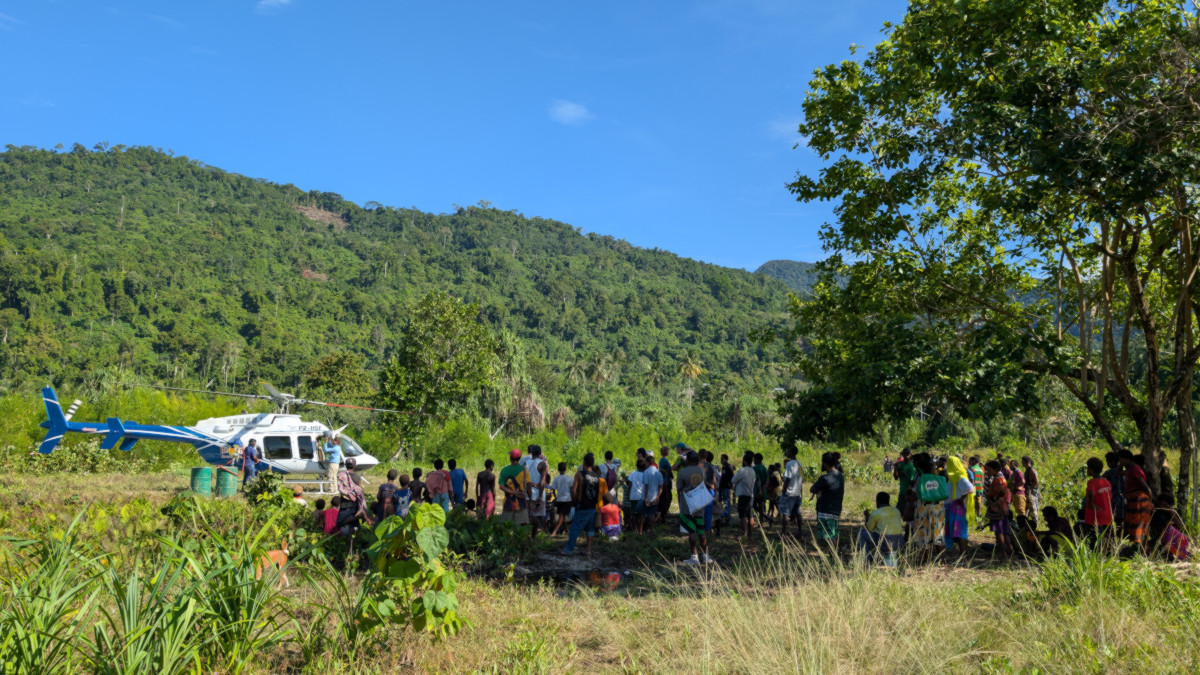
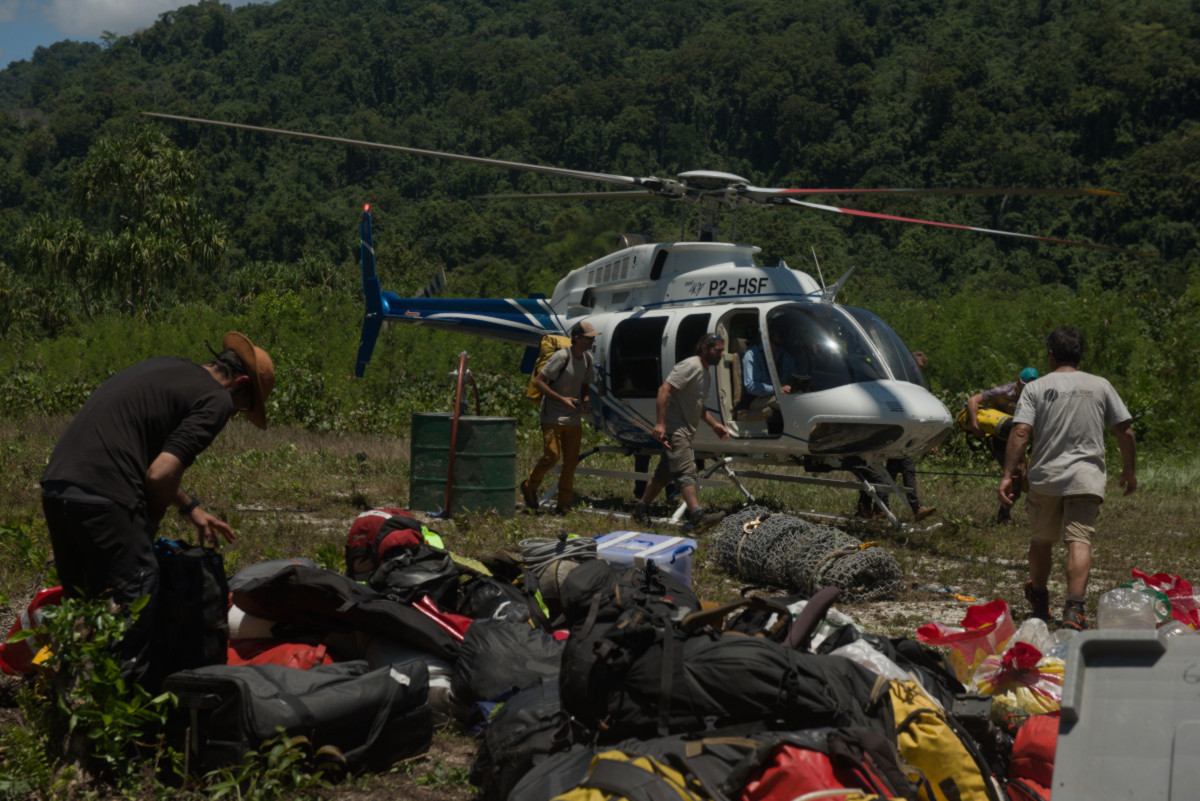
8 February thus became a pivotal day. It was a decisive – and costly – day, as Bernard brought the helicopter back from Kimbe to transport equipment to the camps. The operation was strategic: without this cargo, the expedition could not scale up.

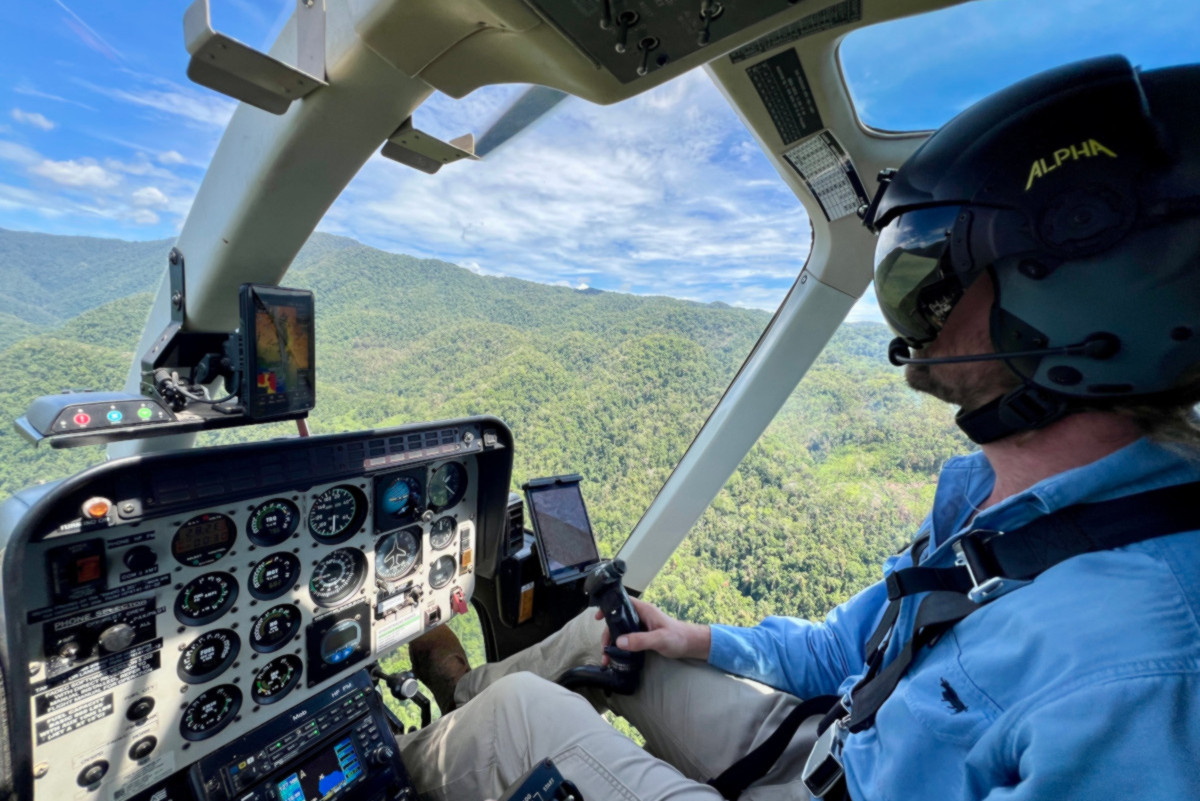
But since the Bell 407 was being mobilised, it made sense to optimise the flight. A helicopter reconnaissance mission was added to the programme, heading for the plateaus upstream of Galuwé. The idea had been germinating for several days: to move Camp 1 to an area potentially richer in sinkholes, losses and chasms. To find the sector that would tip the expedition into success.

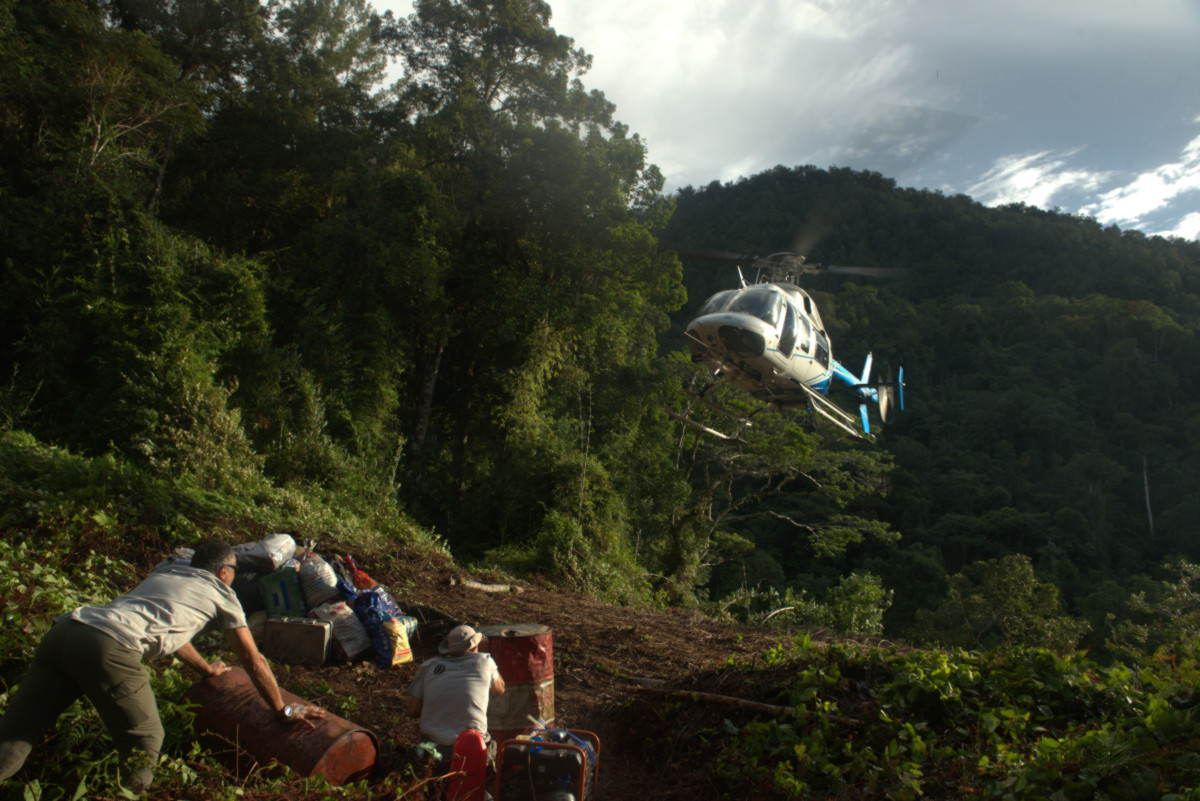
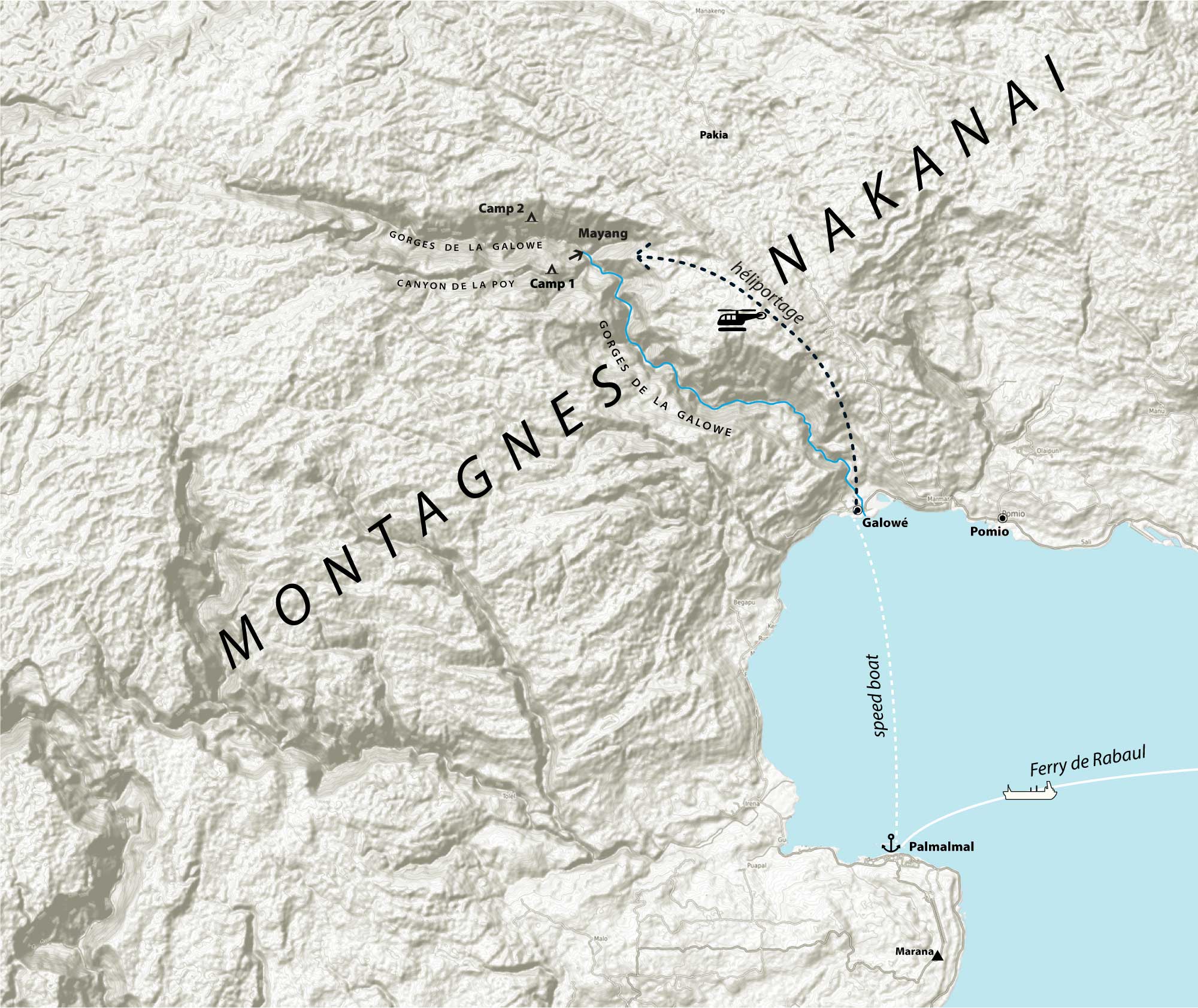
At 7:45 a.m., the Bell 407 arrives and lands on the drop zone at Camp 1. The rotor's blast flattens the vegetation and kicks up dust and leaves. There is no time to waste: with the rotor still turning, Bernard and Michel immediately board the helicopter. They head for Camp 2 to pick up Lionel and conduct reconnaissance of potential drop zones on the high plateaus and the right bank of the Galuwé River (in anticipation of a possible relocation of Camp 1 during the second phase of the expedition). The next step is phase two, which involves organising and collecting the equipment now delivered to Palmalmal in order to supply each camp.

Sea freight arrives at Camp 2

Inside the cabin, the programme remains on hold. Depending on the results of this reconnaissance, two options are emerging:

- pick up Didier and Christophe and drop them off at a viable landing zone, in order to carve out a future drop zone for Camp 3 during the day;

- or consider sending Bernard, Michel, Didier and Christophe on a six-day autonomous mission to open up the area and set up this new advanced camp 3 when the teams change over.

But the mountain decides otherwise. Seen from the sky, reality sets in: a compact, continuous sea of vegetation with no exploitable gaps. There is no area where the aircraft can land safely. The idea of a Camp 3 is fading, at least for the time being.

The verdict is pragmatic: rather than tempting fate, it will probably be necessary to regroup. Perhaps move Camp 1 to Camp 2. Concentrate the teams where several sinkholes have already been identified. The choices to be made in the coming days will be difficult!

Despite this new setback in the reconnaissance phase, 8 February still marks a turning point. The equipment is finally here. The resources are in place. All that remains is to make the right choices. The expedition is entering a new phase — more committed, more ambitious. The mountain, meanwhile, continues to keep its secrets.

View of both camps
View of both camps

9 february — Ralapusa

As soon as the freight is delivered, exploring the Ralapusa chasm, previously identified during a helicopter flyover, becomes the priority at Camp 2. Today, Nicolas, Katia and Mehdi are part of the team. At dawn, the camp is just waking up when the team sets off. At 9:30 a.m., they are at the top of their objective, on the Belvedere, facing the unknown.

On their way to the Ralapusa sinkhole
Objective achieved!
Objective achieved!
Objective achieved!
Objective achieved!
A short break before setting off on our exploration

Embarking on such a descent cannot be improvised. Before them lies a maze of possible routes. They must read the terrain, guess the best option, avoid unstable areas prone to slipping, be wary of trees with fragile roots, and look for solid rock when it surfaces. Suspended at the end of a rope, they progress slowly, cutting away anything necessary with a machete to clear a path. Every metre is hard-won. Every anchor is carefully considered.

And finally inside!
And finally inside!
And finally inside!
And finally inside!

Nicolas is in the lead, and three and a half hours of sustained effort will be needed to finally reach the bottom of the depression. There, at the drainage point, the atmosphere changes. A mixture of relief, excitement and curiosity. The moment is intense, almost suspended. Then very quickly, the exploration resumes: heading downstream, then upstream. They need to see. To understand. To gauge the potential.

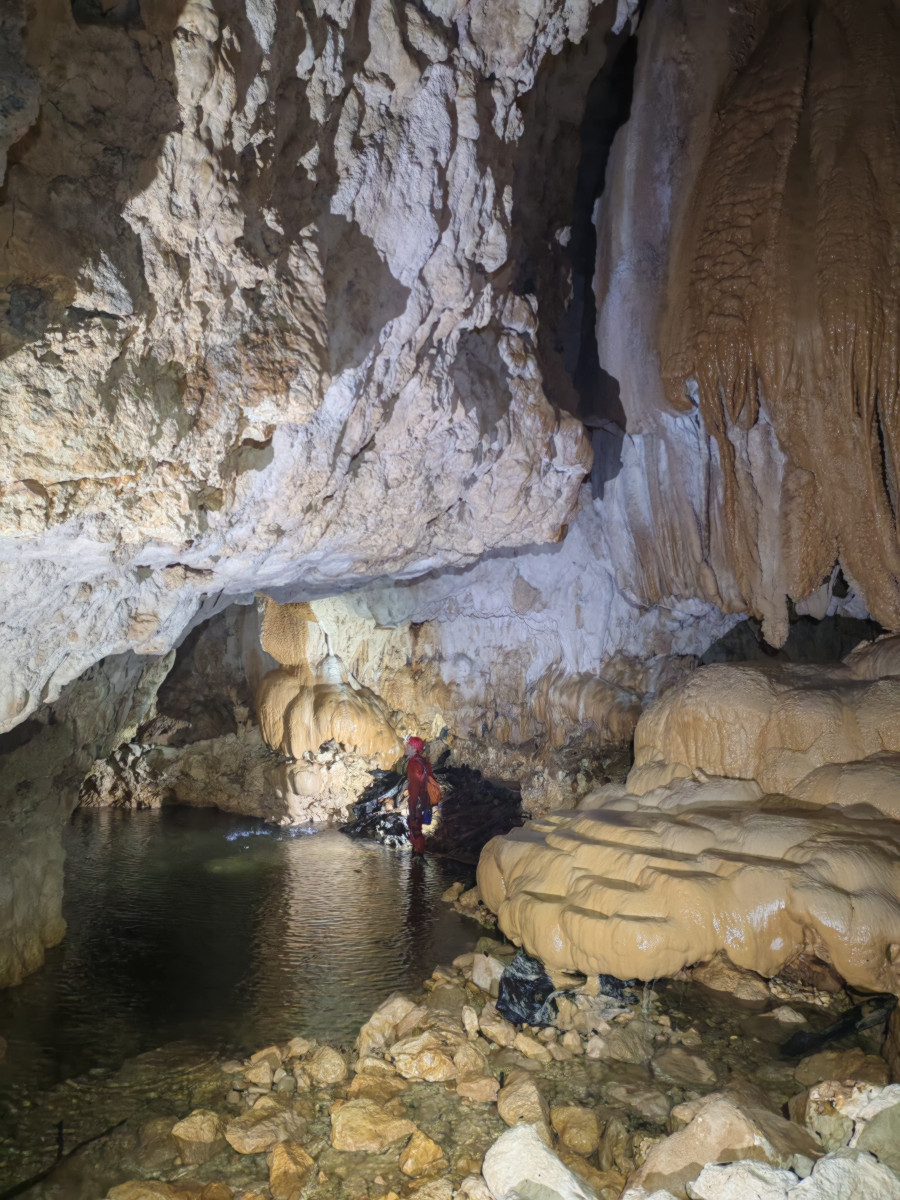
And a surprise awaits them. Downstream. After a 5- to 7-metre drop, the gallery extends for more than seventy metres before a climb stops their progress. It will need to be equipped during a future outing.

A pleasant surprise: the cave continues upstream and downstream!

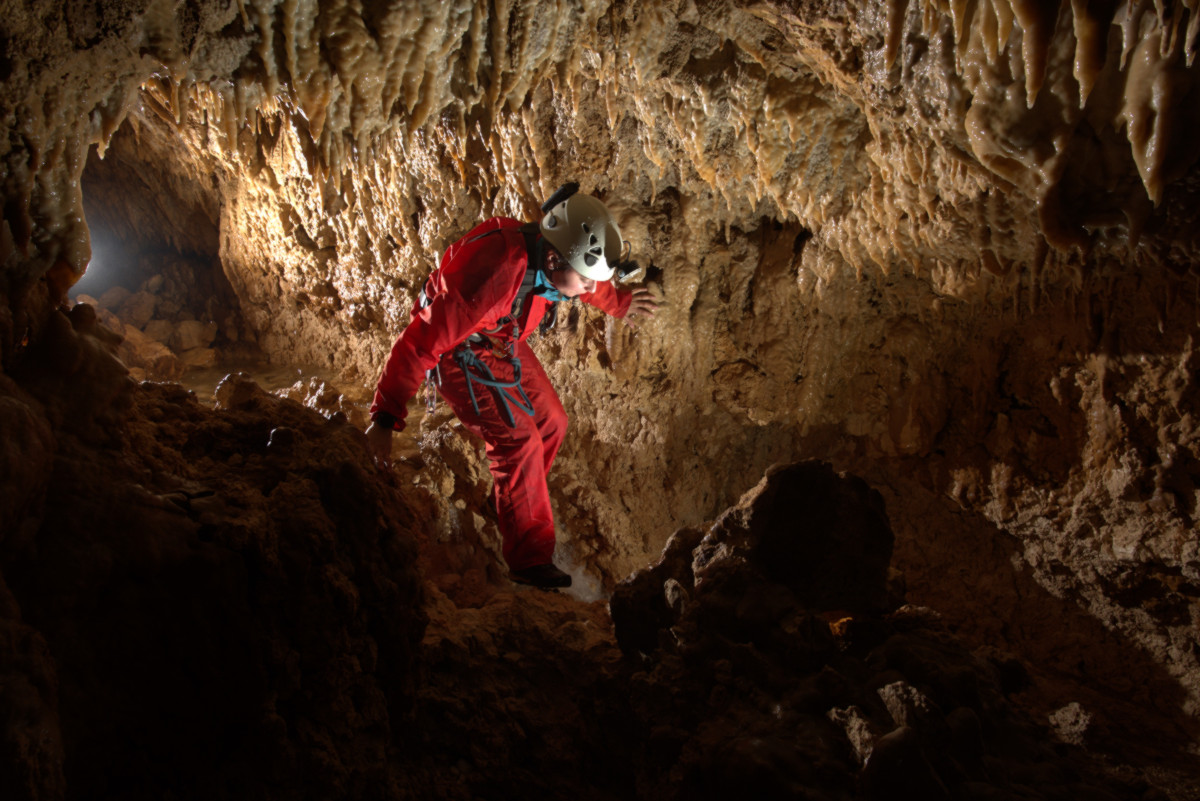
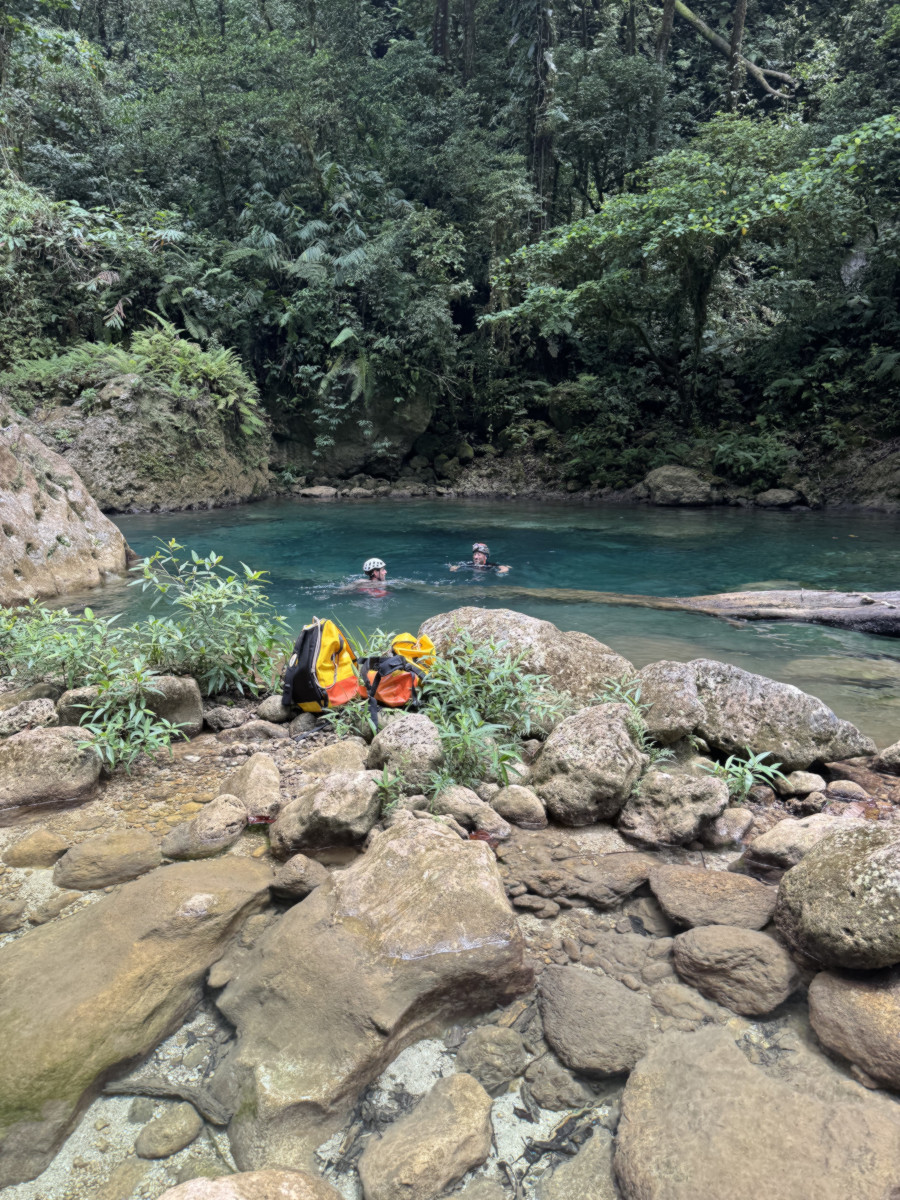
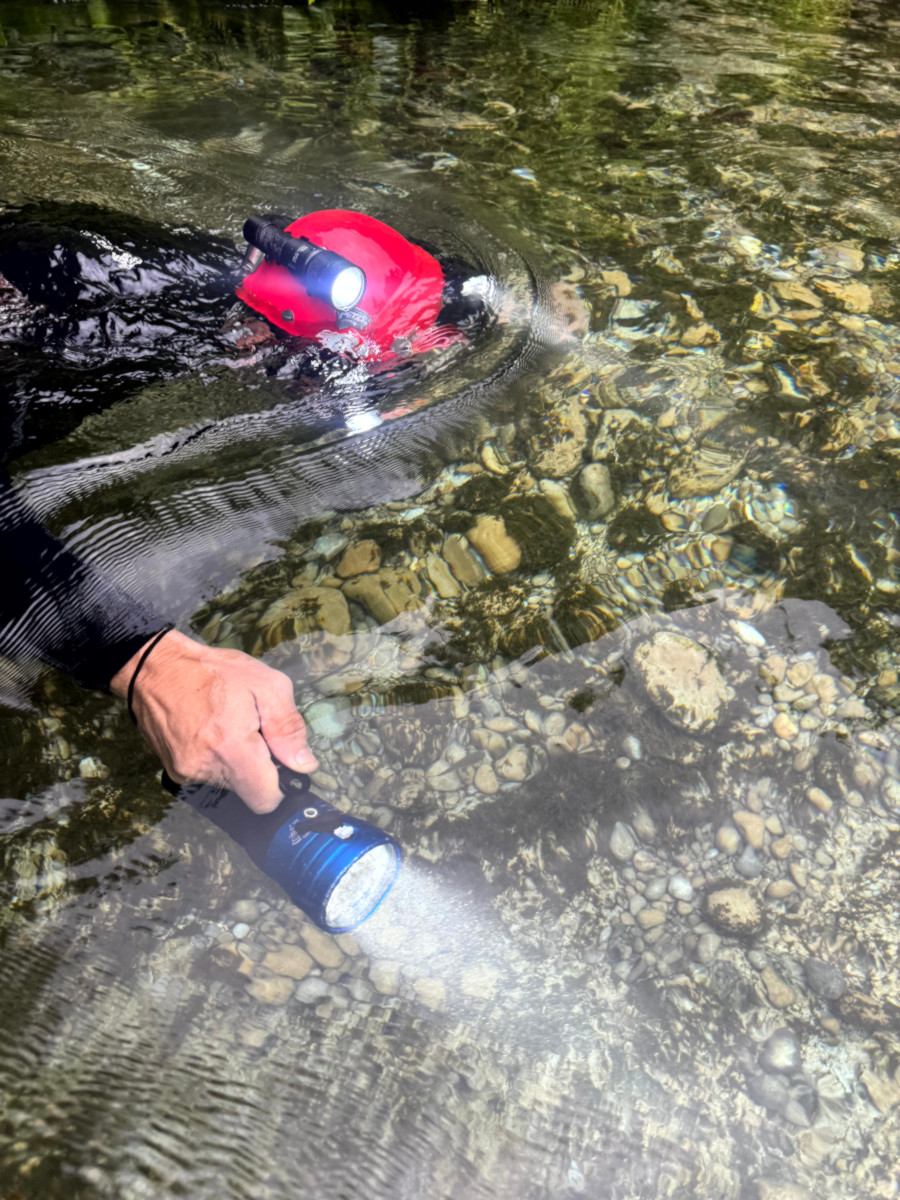
Upstream, the excitement continues. After climbing almost three hundred metres up the riverbed, the gallery opens up, vast and welcoming. Immaculate blue pools punctuate the route, almost unreal in the light. A discreet flow of 3 to 5 litres per second accompanies the progression. The cave is alive. For those lucky enough to experience this moment, the emotion is too strong: swimming is a must. A simple, almost childlike moment in the heart of a grandiose setting.

The verdict is clear: it continues, and well, both upstream and downstream. Finally, a real caving objective, solid and promising, which offers a glimpse of great prospects for the rest of the adventure.

At the time of writing this update, exploration of this cavity is still ongoing.

8–10 février — Changing in process

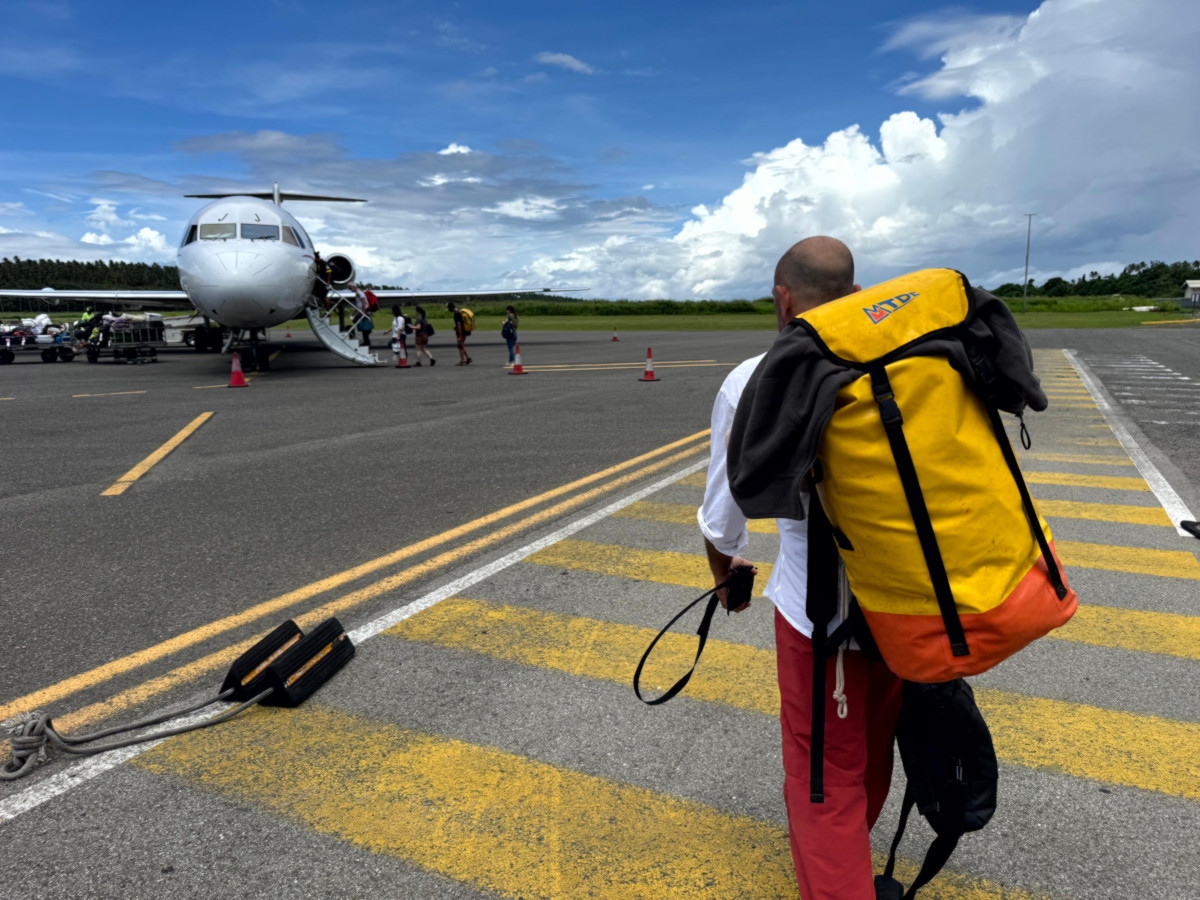
On 8 February, the next shift is already being organised. Bogdan and Tom take off from Australia. Jessica leaves from Canada. Sophie from Belgium. Tudor from Romania.

On the evening of the 9th, Yann, Anthony and Monika board their flight from Roissy.

Only four days left on site for the ‘July group', who will leave the camps by helicopter on 14 February.

The expedition is changing. The mountain, however, remains unchanged.


Publication précédente


Ultima Patagonia 2023

Madre de Dios

Expédition Ultima Patagonia 2023

Ultima Patagonia 2019

Madre de Dios

Expédition Ultima Patagonia 2019

Ultima Patagonia 2017

Madre de Dios

Expédition Ultima Patagonia 2017

Ultima Patagonia 2014

Diego de Almagro

Expédition Ultima Patagonia 2014

Ultima Patagonia 2010

Fourth expedition to Madre de Dios

Expédition Ultima Patagonia 2010

Ultima Patagonia 2008

Second Franco-Chilean expedition

Expédition Ultima Patagonia 2008

Ultima Patagonia 2006

First Franco-Chilean expedition

Expédition Ultima Patagonia 2006

Bornéo 2002

Expedition into the caves of Kalimantan

Expédition Bornéo 2002

Mongolia 2001

Reconnaissance expedition

Expédition Mongolie 2001

Ultima Patagonia 2000

Great expedition to Madre de Dios

Expédition Ultima Patagonia 2000

Ultima Esperanza 1997

First expedition on Diego de Almagro

Expédition Ultima Esperanza 1997

Diego de Almagro 1995

First reconnaissance

Expédition Diego de Almagro 1995